



Tabla de contenidos
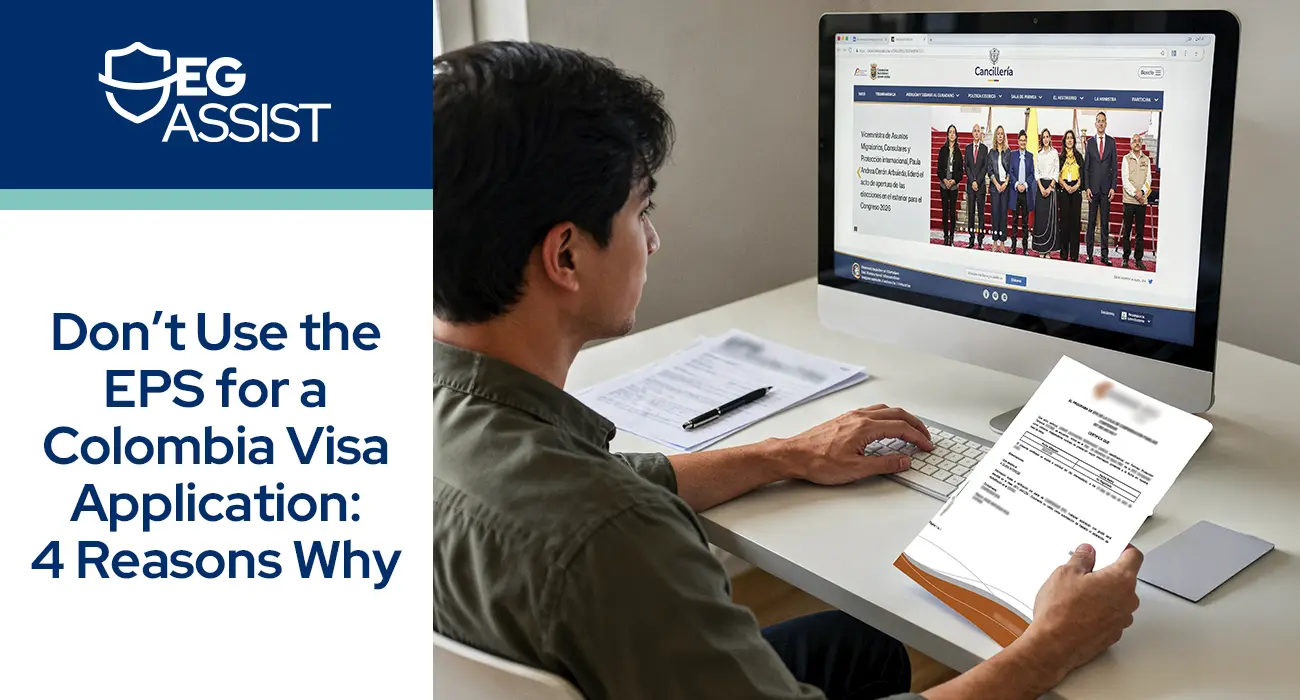
Are you thinking about using the EPS for a Colombia visa? If you are currently preparing an application, relying on the public Social Security System to meet health policy requirements is an error that can result in significant delays due to the lack of coverage benefits that EPS doesn’t include and are mandatory by law.
In the past, a gray area allowed some foreigners to enroll in an EPS (Entidad Promotora de Salud) before obtaining their Colombia visas. However, since the implementation of Resolution 5477 of 2022, health protection has become the absolute priority for the Colombian government. The current standards require an all-risk policy to ensure that the Colombian state doesn’t absorb the costs of medical emergencies or repatriations for foreign residents. In this blog, we explain 4 reasons why you shouldn’t use an EPS as a health policy.
Can an EPS fulfill the mandatory health requirements for Colombia visa?
Many foreigners who have lived in Colombia or have been recently affiliated with the public system assume that their contributions to an EPS are enough to satisfy the Colombian Goverment, but they’re not. It’s a common misconception to believe that all health policies are the same. However, the Ministry of Foreign Affairs (MRE) requires very specific coverages that EPS doesn’t have.
1st reason: An EPS doesn’t cover the specialized all-risk and repatriation requirements
While an EPS provides basic medical appointments and certain emergency services in Colombia, it is technically and legally unable to meet visa standards. The Colombian government requires an all-risk policy, meaning the certificate must explicitly cover every possible scenario.
Do you Need a Health policy for a Colombian Visa Applications?
Foreigners, when applying for a Colombian visa, health policy is key. EG Assist offers you the best plans and prices wich includes the coverages required for the Colombian goverment.
Can I enroll in an EPS and use it for a Colombian visa application?
While it is true that the Colombian government ensures that everyone can access emergency medical care, there is a clear distinction between the right to health and a legal affiliation. It is a common mistake and poor practice for many foreigners to be incorrectly advised to register with an EPS using only their passport.
2nd reason: It is not legal to enroll in an EPS as a tourist
The legal framework for health affiliation in Colombia is highly specific and leaves no room for interpretation during the visa process. Under Decree 780 of 2016, which regulates the Health and Social Protection Sector, affiliation is a formal act that is mandatory only for individuals who already hold residency status. A passport with a tourist entry stamp doesn’t grant the legal standing required for regular enrollment in the Social Security System because it represents a temporary stay, not residency. While the law lists the passport as a valid identification document, its use for adults in this context is considered a technical inconsistency that the Ministry of Foreign Affairs flags immediately.
According to Article 2.1.3.2 of Decree 780 (2016), affiliation with the health system is reserved for residents or individuals possessing a valid stay permit. Consequently, since the very purpose of a Colombia visa application is to obtain that legal status, you cannot legally be an EPS affiliate before the visa is granted.
As stipulated in Article 2.1.3.4 of Decree 780 (2016), even if an EPS advisor enrolls an individual using a passport, the affiliation must be updated with a valid residency identification once obtained. Because of this mandatory update requirement and the lack of international coverage, the Ministry of Foreign Affairs will not accept this kind of application as proof of the all-risk health policy required.
Instructional Warning for Pensioners
It is critical for pensioners to understand that, according to Article 77 of Resolution 5477 (2022), foreign retirees are NOT legally allowed to join with an EPS for visa purposes or after getting their Retirement Visa.
If you manage to obtain your Retirement Visa and your Foreigner ID Card (Cédula de Extranjería), do not enroll in the EPS. This can negatively impact future visa applications, potentially leading to a rejection or forced withdrawal if the government verifies that you have an active EPS affiliation in the ADRES system.

Can I use a monthly medicina prepagada plan or premium EPS for a Colombia visa application?
One of the most frequent mistakes in a colombia visa application is assuming that a monthly payment plan (whether through the EPS or a Medicina Prepagada) is sufficient for the Ministry of Foreign Affairs. It is a fundamental technical requirement in Colombia that to access Medicina Prepagada, you must first be an active, paying affiliate of the Colombian health public system. While these services offer excellent local care on a month-to-month basis, the 2026 visa standards are much stricter.
If your health policy for Colombian visas does not align with the duration of your intended stay, you risk receiving a significantly shorter visa approval or facing a complete halt in your administrative process.

3rd Reason: Your health policy must be valid for the entire period of your intended stay
According to the requirements established in Resolution 5477, your health policy for Colombian visas must cover the total time you intend to reside in the country. A monthly affiliation fails this requirement because it does not guarantee long-term, continuous coverage in a single certificate that the goverment can verify for the future.
If the intended stay is for 2 years, it is fundamental to provide a health policy for Colombian visas with 2 consecutive years of coverage, or at least 1 full year.
Impact on visa validity:
Providing a document with a shorter duration often leads the goverment to approve your visa for a shorter period, requiring you to explain your stay or submit new documents, which slows down the entire process.
Type M visa:
For Migrant visas, such as Spouse visa, Domestic Partnership visa, Business visa, Work visa, or others, current 2026 practices suggest that not providing health policy (even if it’s not stipulated as a requirement) often results in approvals of less than 1 year.
Obtain Longer Approvals:
To increase the probability of a longer visa term, it is highly recommended to provide a private health policy for Colombian visas for at least 1 year. If you have the financial means to obtain coverage with a validity of more than 1 year, we recommend choosing the maximum available validity (2 or 3 years).
With EG Assist health policy and its Premium Flex Add-On, you can obtain a refund for the time you won’t use if you receive a shorter visa approval.
Get Flexibility on Your Health Policy with Premium Flex
Highly Recommended for Visa Applicants
🔷 For just 100 USD more per policy year
🔷 Full Refund Guarantee
🔷 Date Changes
🔷 Visa Term Adjustment
Apply terms and conditions
Can I use my existing EPS for a Colombia visa renewal?
If you have already lived in Colombia on a previous visa, you likely have a Cédula de Extranjería and are currently affiliated with an EPS. While this is excellent for your day-to-day medical needs, many foreigners think their EPS certificate is sufficient for their next Colombia visa application.
4th Reason: In Colombia, you can’t renew a Migrant or Visitor visa
In Colombia, every “renewal” is technically considered a new visa (subsequent application) with its own set of requirements that applicants must fulfill each time they apply. Even if you were a resident, the goverment prioritizes private health policies that specifically include all-risk and international repatriation, taking into account that your next visa is not a renewal and you have to submit the requirements again.
On the other hand, if you are applying for another category of Visitor (Type V) visas, such as a Digital Nomad visa, Student visa, Medical Treatment visa, Annuity visa, or others, a health policy is also mandatory. The MRE will not accept an EPS certificate for these categories.
For Migrant (Type M) visas, such as the Marriage visa, Partnership visa, or Business Owner visa, being affiliated with an EPS is technically permitted but highly discouraged. During 2026, the Ministry has been granting visas for shorter periods (often less than 1 year). To secure 1, 2, or 3-year approval and protect your accumulated time toward residency, a private health policy is recommended. Remember that Migrant visas, such as Investment visa, Retirement visa, and Freelancer visa, require a mandatory health policy by law.

Explore EG Assist health policy plans, designed for visas in Colombia, and obtain peace of mind with your application
To Sum Up: Why you shouldn’t use an EPS for Colombia visa applications in 2026
A specialized private health policy is your essential gateway to ensuring a successful and stress-free Colombia visa application. The 2026 process highlights the strict enforcement of Resolution 5477 and emphasizes the importance of independent coverage that guarantees full compliance with repatriation and all-risk requirements.
The important aspects that you should not forget from this blog are:
- EPS is locally limited: While the public system provides basic care, it lacks the mandatory international repatriation clauses and explicit all-risk wording required by the Ministry of Foreign Affairs to approve your residency.
- Legal alignment is mandatory: Enrolling in an EPS as a tourist is a technical inconsistency; a valid health policy must be legally issued and independent of the public system.
- Duration impacts your visa: Monthly plans, Medicina Prepagada, or Premium EPS subscriptions create administrative friction with the intended length of stay for your visa application. Providing a long-term private policy is the most effective way to maximize your visa’s validity and avoid approvals of less than one year.
- “Renewals” are new visas: In Colombia, there are no visa renewals. They are technically subsequent applications where private health policies are prioritized.
For a complete walkthrough of the health requirement and to ensure your policy includes all coverage required by the Colombian government, we encourage you to secure an EG Assist health policy. Our specialized plans are designed specifically to navigate the complexities of Resolution 5477, providing you with the exact “All-Risk” certification and mandatory repatriation. By choosing EG Assist, you avoid the technical inconsistencies of the public system and ensure your application is supported by a policy that maximizes your visa’s validity period.
For a complete walkthrough of the health requirement and to ensure your policy includes all coverage required by the Colombian government, we encourage you to secure an EG Assist health policy. Our specialized plans are designed specifically to navigate the complexities of Resolution 5477, providing you with the exact “All-Risk” certification and mandatory repatriation. By choosing EG Assist, you avoid the technical inconsistencies of the public system and ensure your application is supported by a policy that maximizes your visa’s validity period.


Comments
Share your experience or question.
Your comment can inspire and help others who dream of living in Colombia.